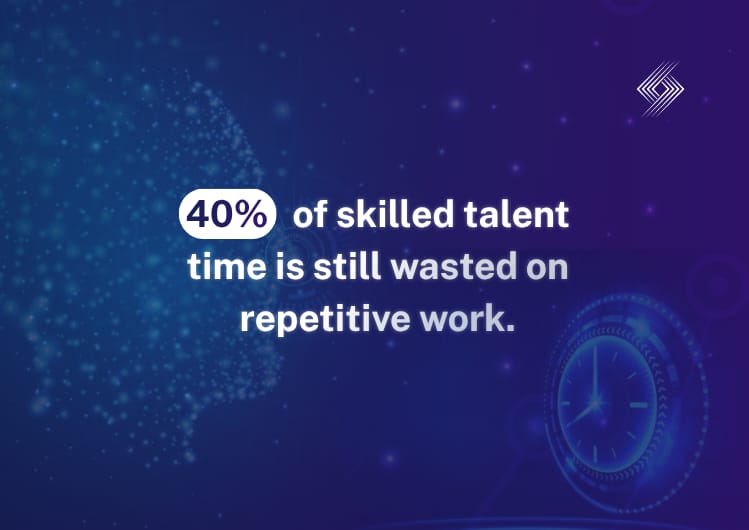
Nearly 40% of professional talent’s time is still squandered on manual, repetitive chores, which reduces productivity and stifles creativity, according to research.
Organizations may increase productivity, free up workers to concentrate on high-value tasks, and unlock more business potential by using workflow automation, AI-powered automation, and streamlined workflows.
How much could you expand your company by doing away with monotonous tasks?
Businesses spend a lot of money recruiting knowledgeable and skilled workers.
Nevertheless, they nevertheless spend about 40% of their time on monotonous, repetitive tasks that deplete their energy rather than provide value. Consider the true meaning of that:
Instead of addressing significant technical issues, an engineer spends hours formatting reports.
● A financial analyst searches for data rather than concentrating on forecasting insightful information.
● A marketing strategist handles spreadsheets rather than developing strategies that yield results.
There are consequences for each hour spent on low-value tasks:
● Missed innovation: fewer ideas reach the market
● Slower delivery: projects stall on administrative steps
● Employee annoyance: work turns into a duty rather than a craft
● Increasing burnout: workload is heavy but impact is modest
In 2025, why does this still occur?
Organizations often struggle with outdated systems and fragmented data that demand constant manual effort, causing inefficiencies even when experienced teams are in place.
Employees lose valuable time trying to keep tasks aligned as workflows spread across multiple platforms that do not communicate with each other.
Adopting new technology is not enough; it requires a cultural shift toward intelligent process automation that enables connected ways of working and smarter, more productive business solutions.
Conclusion:
Using the necessary tools shouldn’t feel like a struggle.
At Analytixhub.ai, we think that the businesses that succeed in the future won’t only be the ones with the best employees; rather, they will be the ones that release its talent from monotonous tasks so they can tackle more complex issues, innovate more quickly, and prosper.